NICOP vs POC: What’s the Difference and Which One Do You Need?
If you are a Pakistani living in the United States or Canada, you may have come across two important identity documents: the National Identity Card for Overseas Pakistanis (NICOP) and the Pakistan Origin Card (POC). Although both documents are issued by Pakistan’s National Database and Registration Authority (NADRA), they serve different purposes and have different eligibility requirements.
Understanding NICOP vs POC is especially important for Pakistani Americans, Pakistani Canadians, dual nationals, and people of Pakistani descent who are unsure which document applies to their circumstances.
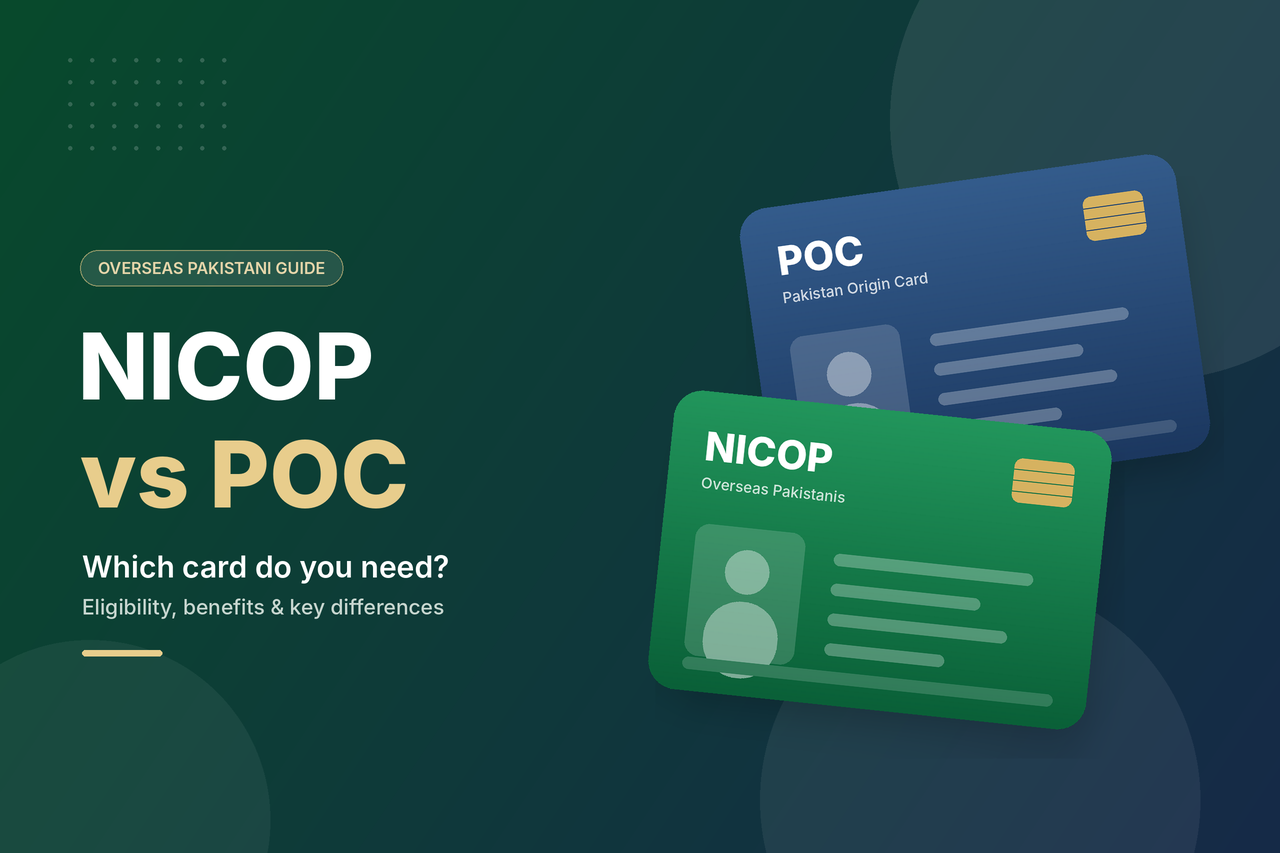
The main difference is straightforward: NICOP is intended for eligible Pakistani citizens living abroad, while POC is generally intended for eligible foreign nationals of Pakistani origin or other qualifying individuals under NADRA’s rules.
However, citizenship history, family relationships, and individual circumstances can make eligibility more complicated.
This guide explains the difference between NICOP and POC, their benefits, eligibility requirements, and how overseas applicants can determine which document may be appropriate.
What Is a NICOP?
The National Identity Card for Overseas Pakistanis (NICOP) is an identity document issued by NADRA to eligible Pakistani citizens residing outside Pakistan.
It serves as evidence of the holder’s registered Pakistani identity and citizenship status, subject to applicable laws and official verification.
Pakistani citizens living in the United States, Canada, the United Kingdom, and other countries may qualify for NICOP.
Who Is Eligible for NICOP?
NICOP eligibility generally depends on Pakistani citizenship.
Potential applicants include:
- Pakistani citizens residing abroad.
- Eligible dual nationals who retain Pakistani citizenship.
- Pakistani children born overseas who qualify for Pakistani citizenship.
- Other individuals who meet NADRA’s applicable citizenship and registration requirements.
A person who holds a US or Canadian passport is not automatically eligible for NICOP. Their Pakistani citizenship status must also be established.
For example, a Pakistani citizen who later acquires Canadian citizenship may remain eligible for NICOP if they lawfully retain Pakistani citizenship.
However, citizenship arrangements and eligibility depend on the applicable laws and the individual’s circumstances.
Applicants should confirm their status through official Pakistani authorities.
If you are eligible for a first-time card, learn more about New NICOP Application Assistance.
What Is a Pakistan Origin Card (POC)?
The Pakistan Origin Card (POC) is a document issued by NADRA to eligible foreign nationals who meet Pakistan’s applicable origin or relationship-based eligibility requirements.
Unlike NICOP, POC is not proof of Pakistani citizenship.
It is intended to provide specified privileges to qualifying foreign nationals with relevant connections to Pakistan.
A POC may be appropriate for certain individuals of Pakistani origin who are not Pakistani citizens.
Eligibility can depend on previous citizenship, family relationships, ancestry, and other factors defined by NADRA.
Who Is Eligible for POC?
Depending on applicable rules, potential POC applicants may include:
- Certain foreign nationals who previously held Pakistani citizenship.
- Eligible foreign nationals with Pakistani parents or grandparents.
- Certain foreign spouses of Pakistani citizens or eligible persons of Pakistani origin.
- Other applicants who satisfy NADRA’s official eligibility criteria.
Not everyone with Pakistani ancestry automatically qualifies for a POC.
Applicants should review the current eligibility requirements and provide the appropriate supporting evidence.
For more information, visit our New Pakistan Origin Card Assistance page.
NICOP vs POC: Key Differences Explained
Although NICOP and POC are both issued by NADRA, they have different legal purposes.
| Feature | NICOP | POC |
|---|---|---|
| Full Name | National Identity Card for Overseas Pakistanis | Pakistan Origin Card |
| Issuing Authority | NADRA | NADRA |
| Who Can Apply? | Eligible Pakistani citizens living abroad | Eligible foreign nationals of Pakistani origin or other qualifying individuals |
| Citizenship Status | For Pakistani citizens | Does not grant Pakistani citizenship |
| Main Purpose | Pakistani identity documentation for overseas citizens | Recognition of qualifying connections to Pakistan and associated privileges |
| Eligibility | Based on Pakistani citizenship | Based on Pakistani origin, previous citizenship, or qualifying family relationships |
| Dual Nationals | Eligible if they retain Pakistani citizenship and meet applicable requirements | May be relevant to qualifying foreign nationals who are not Pakistani citizens |
| Travel to Pakistan | May provide visa-free entry privileges under applicable rules | May provide visa-related entry privileges under applicable rules |
| Property Rights | Subject to rights and restrictions applicable to Pakistani citizens | Certain property-related privileges may apply under Pakistani law |
| Application Method | Official NADRA application channels | Official NADRA application channels |
| Renewal | Available subject to NADRA requirements | Available subject to NADRA requirements |
| Validity | Depends on card type and applicable rules | Depends on card type and applicable rules |
The most important distinction is citizenship.
A NICOP holder is an eligible Pakistani citizen, whereas a POC holder may be a foreign national with recognized ties to Pakistan.
NICOP vs POC for US Citizens of Pakistani Origin
Pakistani Americans often face questions about which identity document they should apply for.
The answer depends primarily on their Pakistani citizenship status.
Scenario 1: Pakistani Citizen Living in the USA
Consider someone who was born in Pakistan, moved to New York, and continues to hold Pakistani citizenship.
If that person meets NADRA’s requirements, NICOP will generally be the relevant identity document.
If their existing NICOP has expired, they may need to follow the official renewal procedure.
Applicants who need help understanding the process can explore our NICOP Renewal Assistance.
Scenario 2: US Citizen Who Also Holds Pakistani Citizenship
A person who lawfully holds both US and Pakistani citizenship may qualify for NICOP.
Dual nationality arrangements must be considered carefully, particularly where an applicant’s citizenship history is complex.
The possession of two passports does not replace the need to establish eligibility under Pakistani law.
Scenario 3: US Citizen With Pakistani Ancestry but No Pakistani Citizenship
An individual born in the United States to a family of Pakistani origin may need to determine whether they are recognized as a Pakistani citizen.
If they are not a Pakistani citizen, POC may be relevant if they meet NADRA’s eligibility requirements.
They should not assume that ancestry alone establishes eligibility for either document.
Scenario 4: Former Pakistani Citizen
Someone who previously held Pakistani citizenship but later relinquished it may be eligible for POC, depending on their circumstances and applicable rules.
Such applicants should review their citizenship history and official documentation before selecting an application category.
For applicants based in the United States, Pakistan Identity offers independent assistance through its location pages, including NADRA Card New York and NADRA Card Houston.
NICOP vs POC for Pakistani Canadians
The distinction between NICOP and POC is equally important for Pakistani communities living in Canada.
Canadian citizenship alone does not determine which Pakistani identity document a person should hold.
Pakistani Citizens Living in Canada
Eligible Pakistani citizens residing in Toronto, Montreal, Ottawa, Vancouver, Calgary, and other Canadian cities may apply for NICOP through authorized NADRA channels.
This can include eligible dual nationals who retain Pakistani citizenship.
Canadian Citizens of Pakistani Origin
Canadian citizens with Pakistani ancestry who do not hold Pakistani citizenship may qualify for POC if they meet NADRA’s criteria.
Applicants should review their family records, citizenship history, and relevant official requirements.
Pakistani-Canadian Children
Children born in Canada to Pakistani parents may have potential Pakistani citizenship rights depending on the applicable laws and family circumstances.
Parents should verify the child’s citizenship status before selecting NICOP or POC.
Birth certificates, parental identity records, and additional documentation may be required.
Applicants seeking independent assistance can explore our NADRA Card Toronto and NADRA Card Vancouver pages.
NICOP vs POC: Which Is Better for Traveling to Pakistan?
Travel is one of the most common reasons overseas Pakistanis compare NICOP and POC.
Both documents may provide important travel-related privileges, but they are not interchangeable.
Traveling With NICOP
Eligible Pakistani citizens holding a valid NICOP may benefit from applicable visa-free entry arrangements when traveling on a foreign passport.
However, travelers must verify current entry requirements, passport validity, and airline documentation rules before departure.
A NICOP is not a universal substitute for a passport.
Traveling With POC
A valid POC may provide visa-related entry privileges under Pakistan’s applicable rules.
POC holders should confirm current travel requirements, including whether they must carry a valid foreign passport and their POC together.
A POC does not confer Pakistani citizenship.
What If Your NICOP or POC Has Expired?
An expired identity card can create uncertainty when preparing for travel.
Applicants should not assume that an expired NICOP or POC provides the same travel privileges as a valid document.
Before booking or departing, verify the current requirements with NADRA, the relevant Pakistani diplomatic mission, and the airline.
If your card has expired, visit our NICOP Renewal or POC Renewal page for independent assistance information.
NICOP vs POC: Which Document Is Suitable for Property and Family Matters?
Pakistani identity documents may also be relevant to property transactions, inheritance matters, and family documentation.
However, the legal rights available to a person depend on citizenship status, applicable Pakistani law, and the nature of the transaction.
NICOP and Property Matters
NICOP holders are Pakistani citizens, and their citizenship status may be relevant to property ownership and other legal matters in Pakistan.
Additional documentation, verification, or legal procedures may still be necessary.
POC and Property Matters
POC holders may receive certain privileges relating to property and other activities under applicable Pakistani rules.
However, POC privileges are not identical to citizenship rights, and legal restrictions may apply.
Individuals dealing with inheritance, property transfers, or substantial financial transactions should obtain advice from an appropriately qualified Pakistani legal professional.
Family Documentation
Applicants who need to establish registered family relationships may also require a Family Registration Certificate.
An FRC is separate from NICOP and POC and reflects family information recorded in NADRA’s database.
Learn more about Family Registration Certificate Assistance.
Documents Required for NICOP and POC Applications
The documents required for NICOP and POC applications differ because the two cards have different eligibility criteria.
Common Documents for NICOP Applications
Depending on the applicant’s circumstances, supporting documents may include:
- Existing CNIC or NICOP, where applicable.
- Pakistani passport or other citizenship evidence.
- Foreign passport, where applicable.
- Birth certificate.
- Parents’ CNIC or NICOP details.
- Marriage or family records, where relevant.
- Other supporting evidence requested by NADRA.
Common Documents for POC Applications
Depending on the eligibility category, applicants may need:
- Valid foreign passport.
- Evidence of previous Pakistani citizenship, where applicable.
- Parents’ or grandparents’ Pakistani identity records.
- Birth or marriage certificates establishing qualifying relationships.
- Supporting family records.
- Other documentation required by NADRA.
The exact requirements depend on the selected category and the applicant’s circumstances.
For additional guidance, visit our NADRA Document Requirements page.
How to Apply for NICOP or POC From the USA and Canada
Once you have identified the appropriate document, the next step is understanding the official application procedure.
Step 1: Confirm Your Eligibility
Review the current eligibility criteria for NICOP or POC.
If your citizenship status is uncertain, clarify it through official Pakistani authorities before applying.
Step 2: Select the Correct Application Category
Determine whether you need a first-time application, renewal, modification, or replacement.
Different application categories may require different supporting documents.
Step 3: Prepare Your Documents
Gather the identification, citizenship, and family records relevant to your application.
Check that names, dates of birth, and other important information are consistent.
Step 4: Use the Official NADRA Application Channel
Eligible applicants can use NADRA’s official PakID services for supported application categories.
Official portal: https://id.nadra.gov.pk/
Applicants should retain control of their government accounts and verification credentials.
Step 5: Complete Identity Verification
Follow the official instructions for photographs, biometric verification, and any additional identity checks.
Requirements vary by application type.
Step 6: Pay the Official Application Fee
Pay the applicable government fee through an authorized payment channel.
If you choose optional private assistance, confirm its separate cost and scope before purchasing.
Step 7: Track Your Application
Use the official tracking facilities to monitor progress and respond to any requests for additional information.
Approval, issuance, and delivery are controlled by NADRA.
Common Mistakes When Choosing Between NICOP and POC
One of the most common mistakes is assuming that anyone with Pakistani ancestry should apply for NICOP.
NICOP eligibility depends on Pakistani citizenship, not ancestry alone.
Another mistake is applying for POC without reviewing whether the applicant is already a Pakistani citizen.
Applicants may also encounter difficulties when their names, dates of birth, parental information, or citizenship records do not match their supporting documents.
Submitting an application under the wrong category can lead to additional verification requests, delays, or other complications.
Before applying, confirm your eligibility, check the current requirements, and ensure your supporting information is accurate.
How Pakistan Identity Can Help
Pakistan Identity provides independent, optional assistance to eligible applicants living in the United States and Canada.
Our services focus on helping applicants understand the appropriate application category, identify supporting documentation, and prepare for official NADRA procedures.
Whether you need guidance with a new NICOP, POC application, renewal, or identity record modification, our team can help you understand the relevant steps.
We provide remote assistance to eligible applicants in New York, Houston, Los Angeles, Chicago, Washington DC, Toronto, Montreal, Ottawa, Vancouver, Calgary, and surrounding communities.
For assistance, visit our Application Assistance Page or contact us at support@pakistan-identity.com.
Frequently Asked Questions About NICOP vs POC
1. What is the main difference between NICOP and POC?
NICOP is an identity document for eligible Pakistani citizens residing abroad. POC is intended for eligible foreign nationals who meet Pakistan’s origin or relationship-based requirements. POC does not grant Pakistani citizenship.
2. Is NICOP better than POC?
Neither document is universally better. The appropriate choice depends on your citizenship status and eligibility. Pakistani citizens will generally consider NICOP, while eligible foreign nationals of Pakistani origin may consider POC.
3. Can a US citizen apply for NICOP?
A US citizen may qualify for NICOP if they also hold or otherwise establish Pakistani citizenship under applicable law. US citizenship alone does not establish eligibility.
4. Can a Canadian citizen apply for POC?
Yes, a Canadian citizen may qualify for POC if they meet NADRA’s eligibility criteria. Canadian citizenship by itself does not guarantee eligibility.
5. Can I have both NICOP and POC?
Because the documents are intended for different citizenship categories, applicants should confirm their current status and the applicable NADRA rules rather than assume they can hold both.
6. Can I travel to Pakistan with a POC?
A valid POC may provide visa-related travel privileges under applicable Pakistani rules. Travelers should verify current entry requirements and carry the required passport and supporting documents.
7. Does a POC make me a Pakistani citizen?
No. A Pakistan Origin Card does not itself grant Pakistani citizenship.
8. Can children born in the USA or Canada apply for NICOP?
Children who meet Pakistani citizenship requirements may qualify for NICOP. Eligibility and documentation depend on their circumstances and parental records.
9. What happens if my NICOP expires?
You may need to renew your NICOP through NADRA’s official procedures. Verify current travel and identification requirements before relying on an expired card.
10. Can I renew my POC online?
Eligible applicants may use NADRA’s official application facilities for supported POC renewal categories, subject to current requirements.
Conclusion
Understanding the difference between NICOP vs POC is essential for overseas Pakistanis living in the USA and Canada.
NICOP is intended for eligible Pakistani citizens living abroad, while POC is designed for qualifying foreign nationals with recognized connections to Pakistan.
The correct document depends on citizenship status, family history, and NADRA’s official eligibility requirements.
Before applying, review your circumstances carefully, gather the appropriate supporting documents, and consult official government guidance.
If you would like independent help understanding the application process, Pakistan Identity provides optional, paid assistance for eligible applicants in the United States and Canada.
Important Disclaimer: Pakistan Identity is a private, independent application assistance provider. We are not affiliated with, endorsed by, or operated by NADRA, the Government of Pakistan, or Pakistani diplomatic missions. We do not issue government documents, determine eligibility, or guarantee application approval. Applicants may apply directly through official NADRA channels without purchasing our services.